


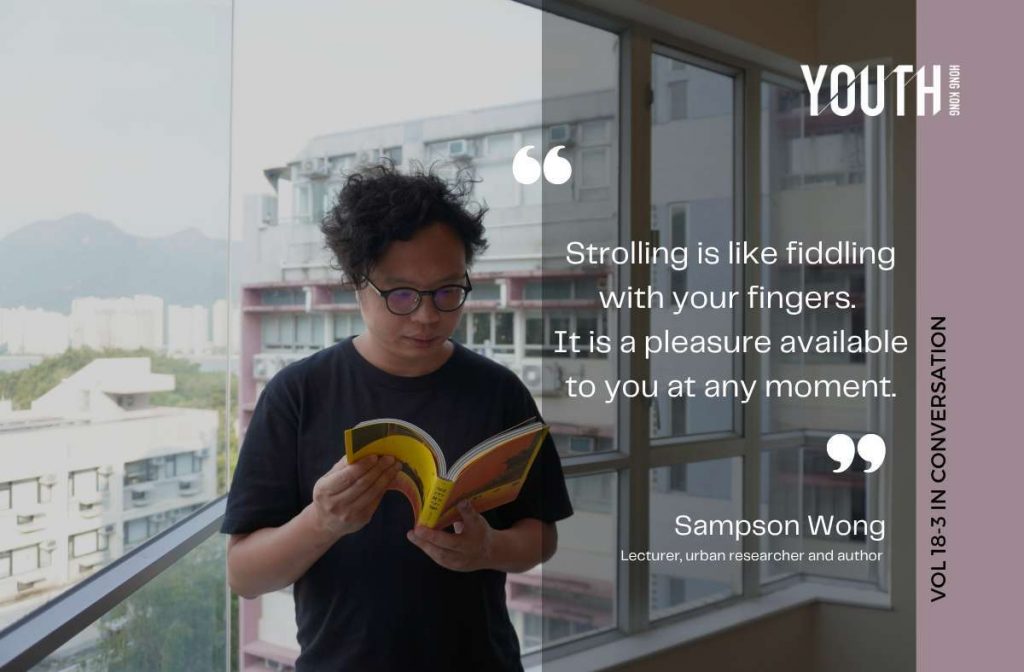
Urban explorer Sampson Wong asks: Have you ever really “walked” through the city you live in?
“The real voyage of discovery consists not in seeking new landscapes, but in having new eyes.” — Marcel Proust
Marcel Proust never made it to the gritty and authentic neighbourhood of Sham Shui Po, but he would have understood Sampson Wong’s project instantly.
Wong, a geography lecturer at The Chinese University of Hong Kong (CUHK), urban researcher, and author of Hong Kong Strollology (香港散步學), spends roughly 50 days a year walking small groups of strangers around Hong Kong, and almost none of that time is spent showing them new landscapes. He takes the participants to old neighbourhoods such as Kwun Tong and Jordan. What he is offering, two hours at a time, is not a tour, but a pair of new eyes with which to look at the place we inhabit.
Wander at Home
Wong’s interest in urbanism and urban walking dates back to 2010, through art projects, research and writing. It wasn’t until 2020, when the borders were shut because of the pandemic, that he started to consolidate the subjects he loves into a cultural project. One day, almost randomly, he posted on Facebook: let’s all do some Hong Kong strollology.
What happened next was that people who were interested signed up and joined the walk to go somewhere they’ve never been before, all within neighbourhoods with which they were already familiar.
The term strollology comes from Swiss sociologist Lucius Burckhardt’s Promenadologie, the experimental practices of becoming aware of how we perceive the environment during reflective walks. Wong borrows this term to give it a new context.
On one walk, he took participants to Prudential Centre, one of the oldest surviving malls in Jordan, to explore the corner of Tak Hing Street where a pocket park is hidden among tall shrubs, and to a building that once housed a school for the city’s Portuguese community.
“If I’m taking you somewhere for the very first time in your life, I feel honoured,” he says.
In a 2025 Time Out global survey, Hong Kong landed 10th among the world’s most walkable cities. Yet in liveability and quality-of-life indices, the city falls behind. Aware of that gap, Wong sees the difference between a city you use and a city you experience.
“A place being good to walk in doesn’t mean you actually walk in it,” he says. “What the hardware (in Hong Kong) facilitates is efficiency — shopping and commuting. It doesn’t necessarily facilitate pausing and relaxing. Very often when we talk about walkability, we’re really talking about efficiency.”
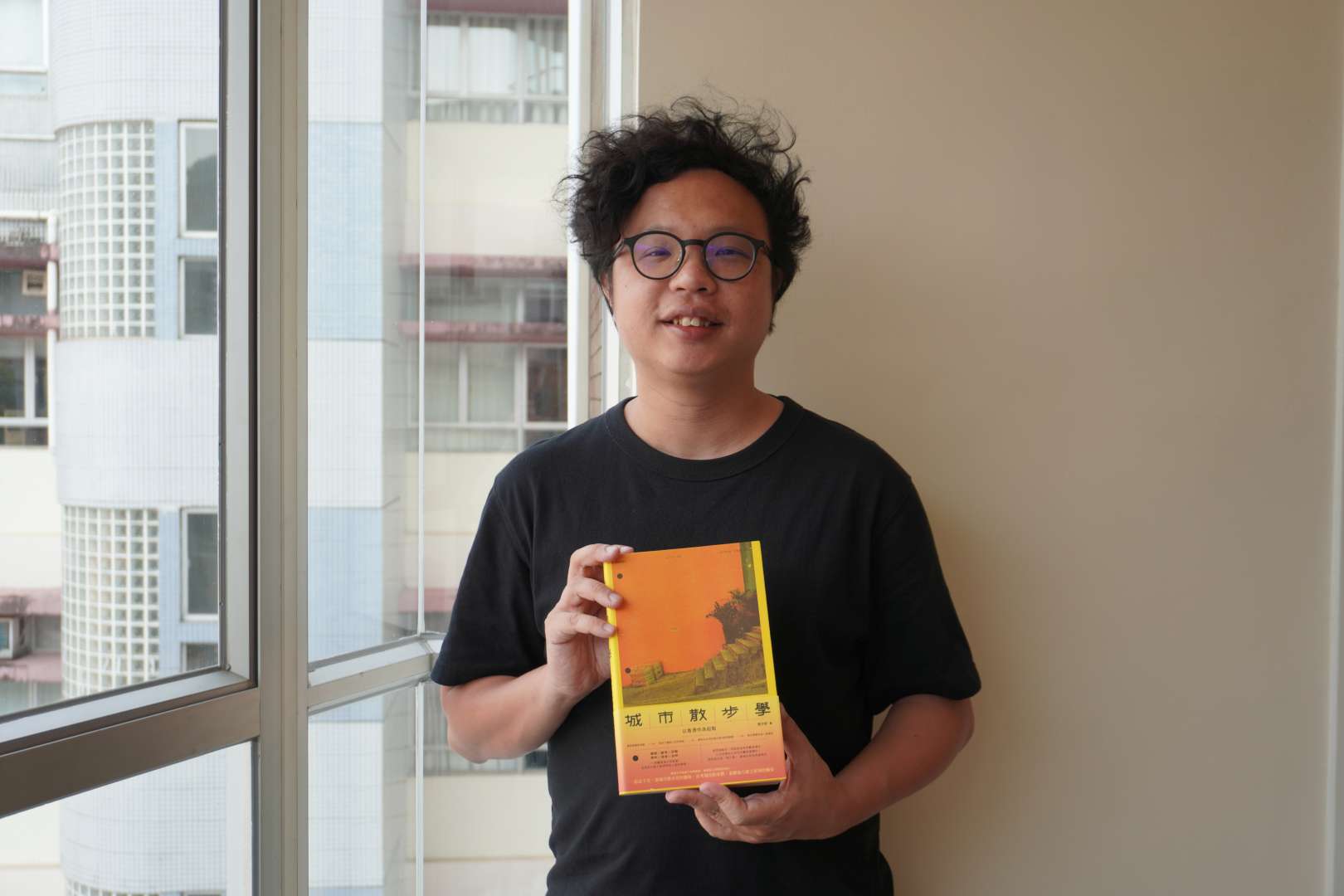
CUHK geography lecturer and author Sampson Wong (Hong Kong Strollology) invites us to rediscover the city we inhabit
Wander Aimlessly
Wong refuses to look at Hong Kong simply through the lens of functionality. While most people picture a guided tour with a flag, a headset, and a long history to learn, his approach is spontaneous, meditative and non-functional. “It’s more of a walk, with no concrete purpose at all. We walk together; we talk and share.”
What he shares with participants on the street is more of an improvised reaction: he notices something, the group talks about it, and he asks what they think. “I use the journey as a practice to sharpen everybody’s senses.”
As residents get used to their busy nine-to-five routine in order to function in the most efficient way possible, they tend to lose their senses and the ability to see what’s special around them. “The more familiar a place is, the more used to it you are. You explore it using your own fixed pattern,” he says.
“Our daily patterns are simply too functional. Hong Kong people are very busy. Apart from going to work, coming home, buying daily necessities, eating, and entertainment, hardly anyone feels they should set aside blank time to explore their surroundings.”
In his new book, subtitled Looking for Happiness in the City, he points out that most of our leisure is destination-based. “You go to the cinema to watch a film, you go to karaoke to sing, you go shopping to shop.” Even our parks and harbourfront promenades get used that way, like jogging lanes and cycling tracks.
A non-functional walk, according to Wong, is more relaxing and playful. Sometimes he simply goes out to look at how the streetlights are designed, while others may go out to count how many types of drain covers Hong Kong has.
Wander Happily
Lately, he’s been drawn to what aimless city walks do to our brains. Conversations with mindfulness researchers highlighted the correlation between walking and mindfulness. While mindfulness turns inward to breath and body, strolling is actively outward-looking. Both require concentration on the present moment, without worrying about tomorrow’s deadline or who you have to call next.
“Strolling is like fiddling with your fingers. It is a pleasure available to you at any moment.”
Along with these mental health benefits, urban walking can also add meaning to everyday life. “It’s something that can make you happy very easily,” Wong says, encouraging city dwellers to learn more about their surroundings and pay attention to what genuinely interests them.
This, he clarifies, is not about acquiring hard knowledge — no dates, architectural styles or names to memorise. Rather, it is about cultivating an intuitive sense of what you enjoy looking at and recognising what is already out there on the street waiting to be seen. In other words, it offers a way of seeing the city with new eyes: an experience that costs less than a plane ticket and begins right outside your door. ■