
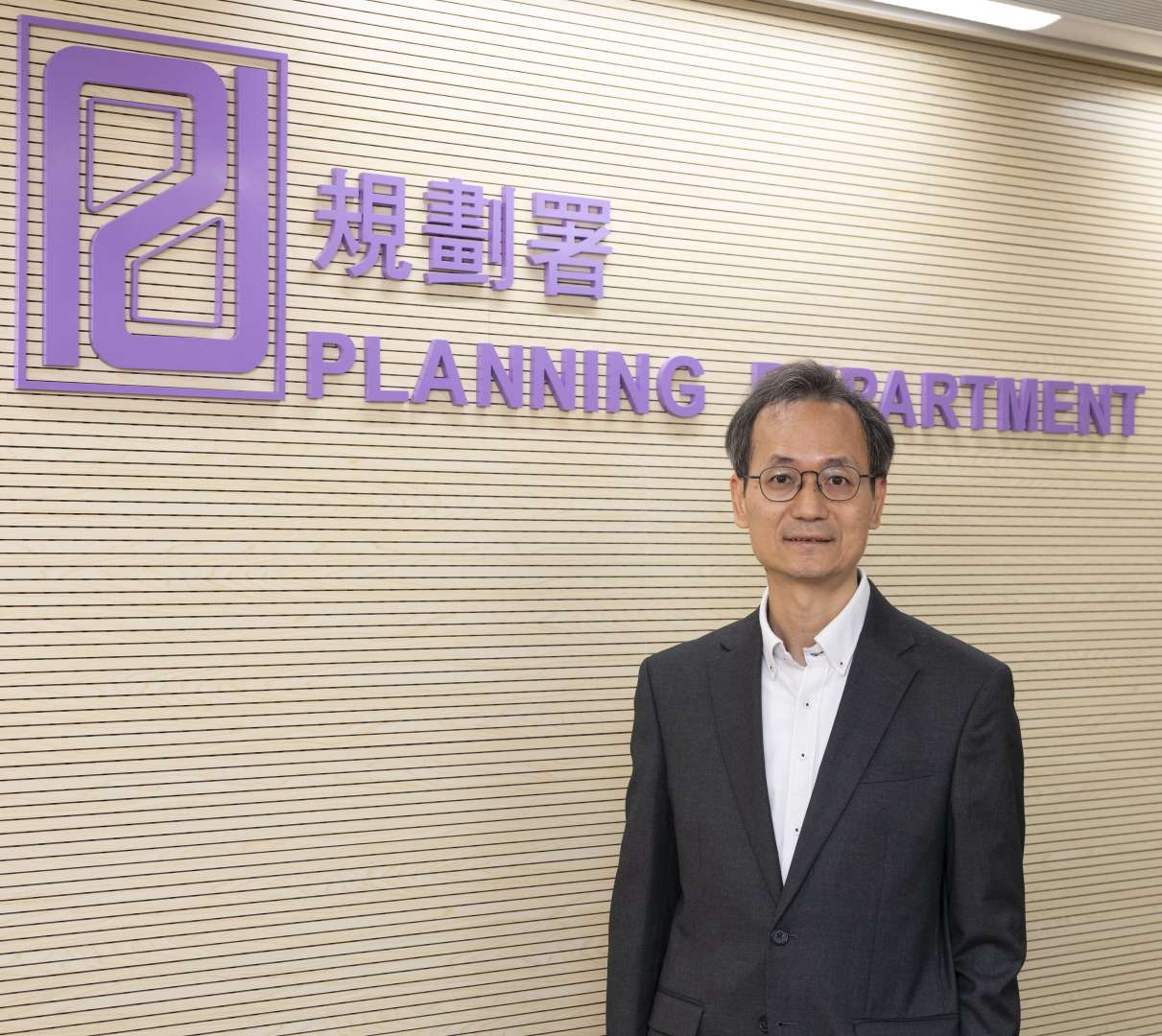
CK Yip, Director of Planning, shares the city’s plan for a liveable, green and economically resilient Northern Metropolis for future generations.
CK Yip spent his childhood in Ta Kwu Ling, a rural area in Hong Kong’s northernmost New Territories that faces Shenzhen across the border. Now the Director of Planning, Yip has witnessed a dramatic transformation in progress, as his old home becomes part of the megaproject called the Northern Metropolis and the new engine for Hong Kong’s development.
Growing up in the countryside gave Yip a special appreciation for Hong Kong’s cityscape: a dense, high-rise city framed by green peaks, harbour waters and islands. The rural and agricultural landscape in Ta Kwu Ling, once dominated by farmlands and rivers, now stands in sharp contrast to Shenzhen, which has evolved into a global technology and financial hub.
To seize economic opportunities while developing within these blue-green habitats, he emphasised the importance of creating a sustainable and liveable Northern Metropolis. As he puts it, “We, as town planners, aspire to create a better living environment where all members of the public, including young generations, can live and work happily.”
Between Mountains and Sea
Yip shares with Youth Hong Kong the city’s overall planning framework, from renewing ageing districts to advancing the Northern Metropolis blueprint. The aim is to shape a liveable city for future generations while preserving its natural and cultural inheritance.
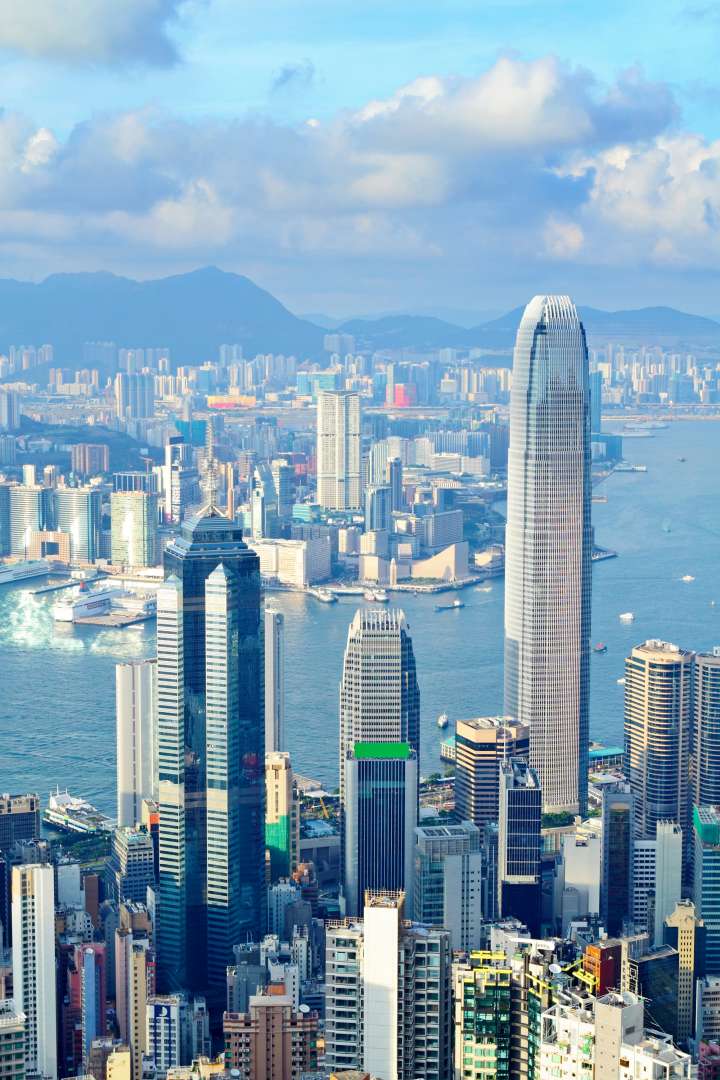
“Hong Kong boasts one of the world’s most distinctive urban landscapes, a high-density city nestled between a natural harbour and mountains,” Yip says. “Whether in urban areas or new towns, it takes only about 20 minutes to reach a country park.”
Yet the same geographic setting that gives Hong Kong its character, also presents considerable challenges in land use planning. With limited land resources, ageing building stock and evolving social and economic needs, town planners play a significant role in shaping the city’s development. “Every piece of land is precious. We must make good use of it,” he says.
He explains that the city adopts a transit-oriented development approach, and for new development areas, a “15-minute neighbourhood” concept with a comprehensive pedestrian and cycle track network. “These together promote compact, mixed-use and walkable communities around public transport hubs that promote walking, cycling and use of public transport, thus creating more sustainable urban environments,” Yip says.
|
To continue to build on Hong Kong’s strengths, long-term planning is essential. The Planning Department conducts a territorial strategic planning review approximately every decade. The review takes into account the latest circumstances and adopts a forward-looking perspective. It sets out the long-term spatial development framework and direction, while identifying development opportunities and land resources to meet social, economic, housing, community facility and environmental needs. The latest framework, Hong Kong 2030+, was published in 2021. Having assessed land demand and supply from 2019 to 2048, it outlines a strategic vision and key development engines, including the Northern Metropolis, as well as the synergistic development of Hong Kong and the Greater Bay Area (GBA). To improve the quality of living environment, Hong Kong 2030+ proposes an enhanced standard of provision for open space from 2 m² to 3.5 m² per person. To enhance the city’s overall liveability and meet aspirations for a more spacious living environment, it has also put forward the vision of increasing the average living space per person. These enhanced standards have been applied in the planning of new development areas. |
Reviving Old Districts
Building a new urban area in the north is one kind of challenge. Renewing the older districts in the city is another. Every year, some 500 more buildings reach 50 years of age, but only about 1/5 of them were demolished for redevelopment.
“To be honest, the living environment in Hong Kong’s old districts is not that pleasing,” Yip says, citing cramped space and dilapidated structures. In areas like Yau Ma Tei, Sham Shui Po and Kowloon City, narrow streets and congested layouts undermine liveability, while building decay often outpaces redevelopment.
Therefore, comprehensive, tailor-made urban renewal plans are urgently needed, with financial viability taken into account. Urban renewal, Yip explains, cannot be resolved through town planning alone; it requires the concerted efforts of multiple stakeholders.
To encourage redevelopment in the old districts, the Planning Department and Urban Renewal Authority developed new mechanisms such as Transfer of Plot Ratio. This allows developers to shift unutilised plot ratio rights from small, unviable sites (sending sites) to larger redevelopment sites elsewhere, including new development areas, thereby enhancing market incentives. Some sending sites may be redeveloped into public spaces and facilities, or conserved and revitalised if they possess historic values.
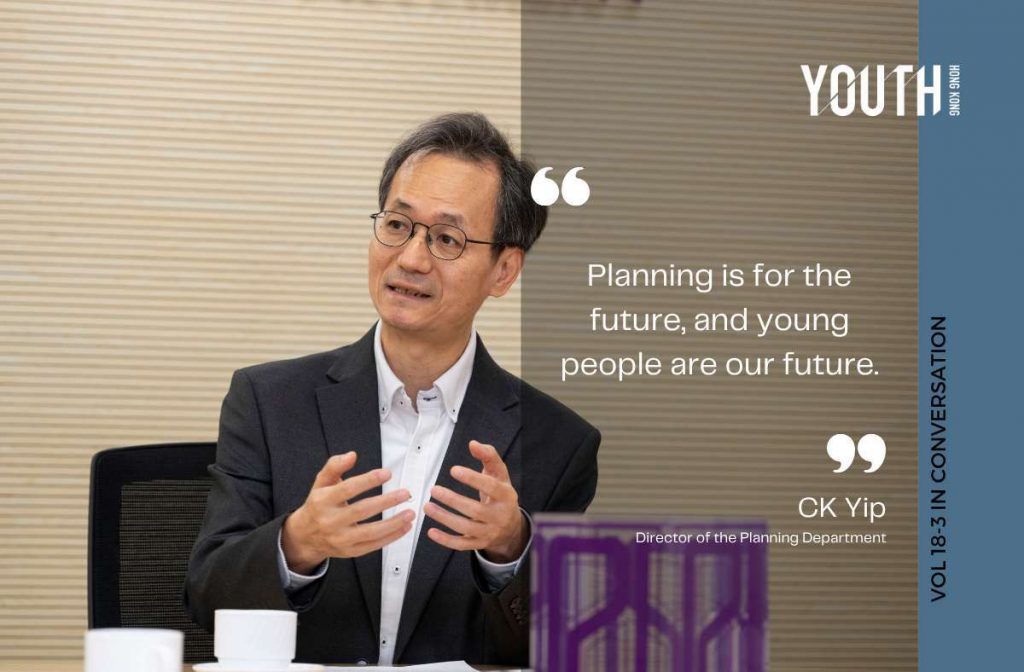
Planning is for the future, and young people are our future.
Developing the Northern Metropolis
While urban renewal addresses the past, the Northern Metropolis vision sets out a plan for a liveable, resilient, industry-driven metropolis for the future. Covering 3,000 hectares of new development land, the project will provide approximately 500,000 new residential units and 500,000 new jobs, thereby creating a new growth engine for Hong Kong’s development.
“For a long time, Hong Kong’s economic focus has been on business and finance, concentrated on two sides of the Victoria Harbour,” says Yip. “To align with the national development strategy, Hong Kong 2030+ proposes the spatial development framework of ‘South-North dual engine’: finance in the south and innovation and technology in the north.”
The strategy aims to build on Hong Kong’s strengths as an international financial centre while integrating into the GBA’s development. Hong Kong will fulfil its role as a “super connector” and “super value-adder,” and support the development of the GBA into a world-class innovation cluster, according to the National 15th Five-Year Plan.
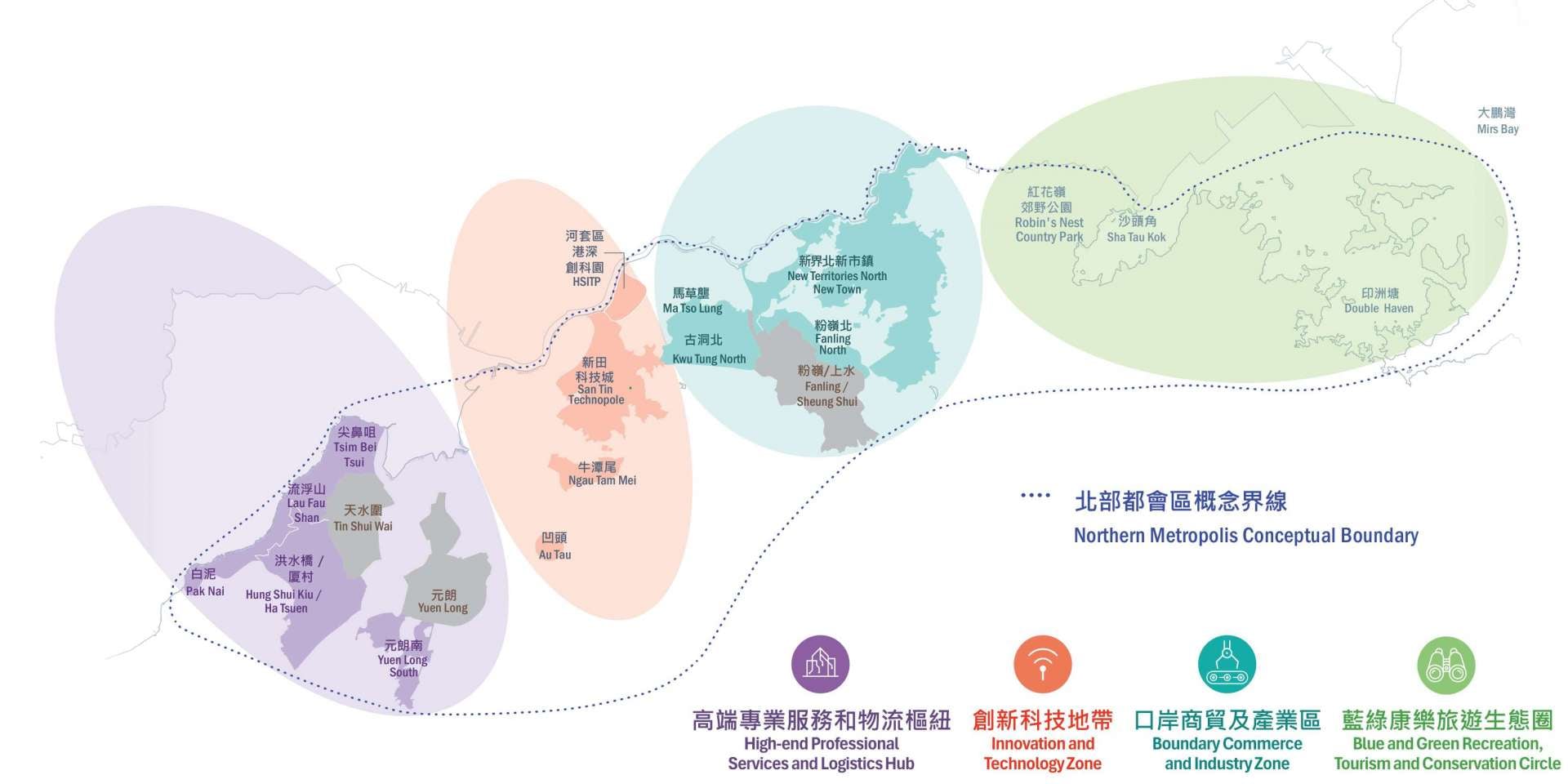
The Northern Metropolis follows three main principles: an infrastructure-led approach to provide comprehensive transport and supporting infrastructural facilities, such as railways and major highways; creating comprehensive communities to offer a high-quality living and working environment. The strategy also takes a new industry-driven and city-industry integration approach (產城融合), integrating workplaces, homes, community and recreation facilities.
There will be four major zones: the High-end Professional Services and Logistics Hub covering the NDAs of Hung Shui Kiu/Ha Tsuen, Yuen Long South and Lau Fau Shan; the I&T Zone including the NDA of San Tin Technopole and Hong Kong-Shenzhen Innovation and Technology Park at the Loop; the Boundary Commerce and Industry Zone covering the NDAs of Kwu Tung North/Fanling North, Ma Tso Lung and New Territories North New Town; and the Blue and Green Recreation, Tourism and Conservation Circle in Sha Tau Kok and Robin’s Nest areas.
“Sustainable development is also our key planning objective,” Yip says. Take “sponge city”, for example: Yip explains how different measures have been adopted to enhance urban resilience in the face of climate change and extreme weather. These include underground stormwater tanks beneath parks, flood retention lakes, porous paving materials for better drainage and reuse of rainwater.
A blueprint of this scale will take decades to realise. By then, global conditions, technologies and economic cycles may look very different. “To cope with changes and opportunities, urban planning must be flexible,” Yip says. In planned university towns, for example, flexi-zoning allows more land uses to provide flexibility and enable quick responses if demand changes.
“Planning is an ongoing process,” Yip says. “We respond to the changing social and economic needs and review the scale and development parameters of our planning schemes in a timely manner.”
With Young People, For Young People
“Planning is for the future, and young people are our future,” Yip says. “Through our outreach programmes, we aim to engage directly with young people, hear their perspectives and their needs, and understand their vision for Hong Kong’s future.”
Indeed, engaging young people is central to the Planning Department’s outreach work, and the recent “Be a Teen Town Planner” competition reflected this, drawing proposals from 280 secondary school students on the Queen’s Hill area in North District.
“The submissions gave us the opportunity to learn how the younger generation sees a community. We get to know their concerns and innovative ideas, such as their proposals for adaptive reuse and heritage conservation of the former Queen’s Hill barracks and disused railway station for community and recreation purposes,” Yip says.
“Hong Kong’s future is shaped by today’s planning decisions.” His childhood living in a rural area in North District gave him a deep appreciation for nature; now he is helping turn his childhood home into a modern, sustainable metropolis while preserving the blue-green habitats and conserving indigenous villages and heritage.
Concluding the interview, Yip encourages young people to participate more actively in the town planning process. “The city will eventually be passed to today’s youth,” he adds, “the future custodians of our city.” ■
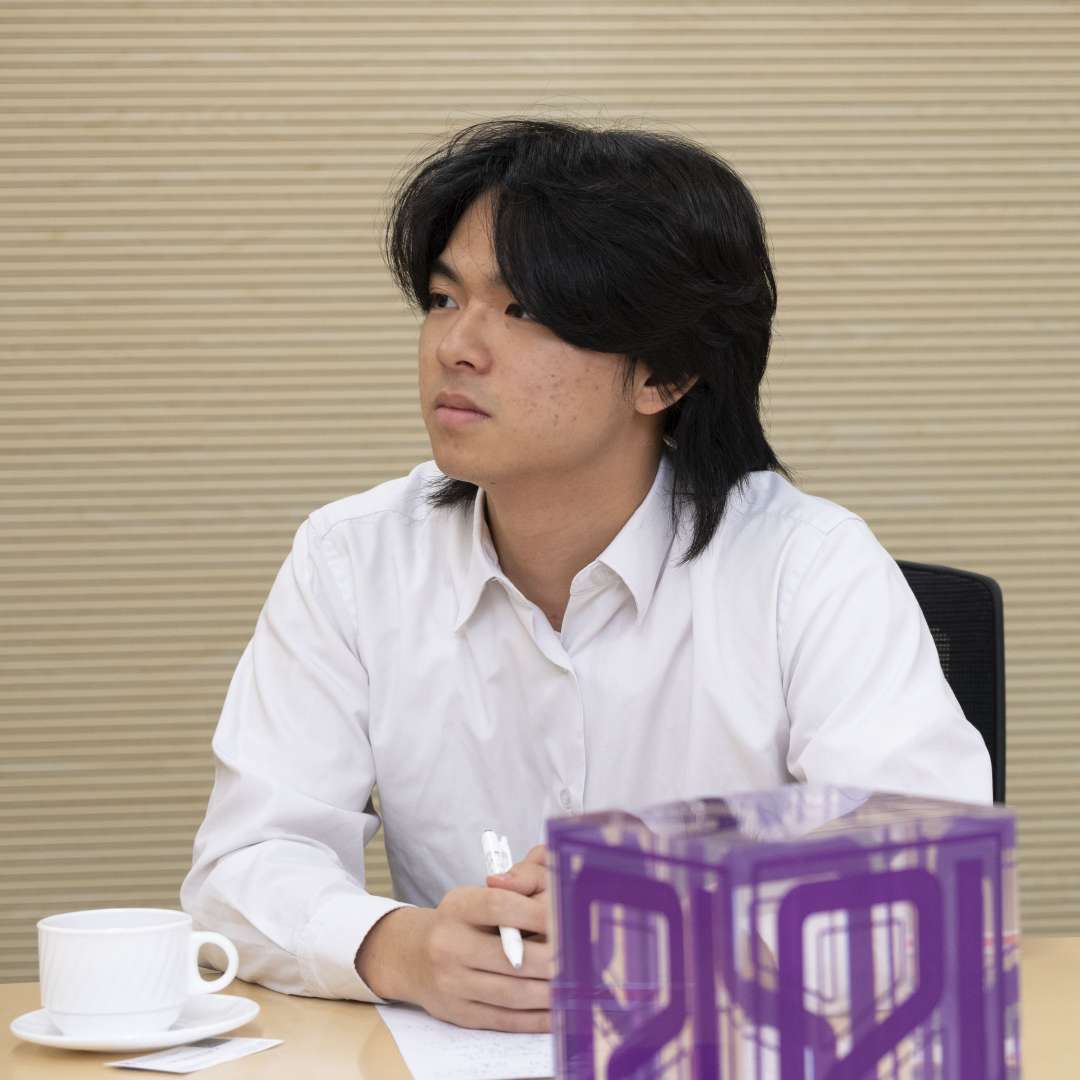
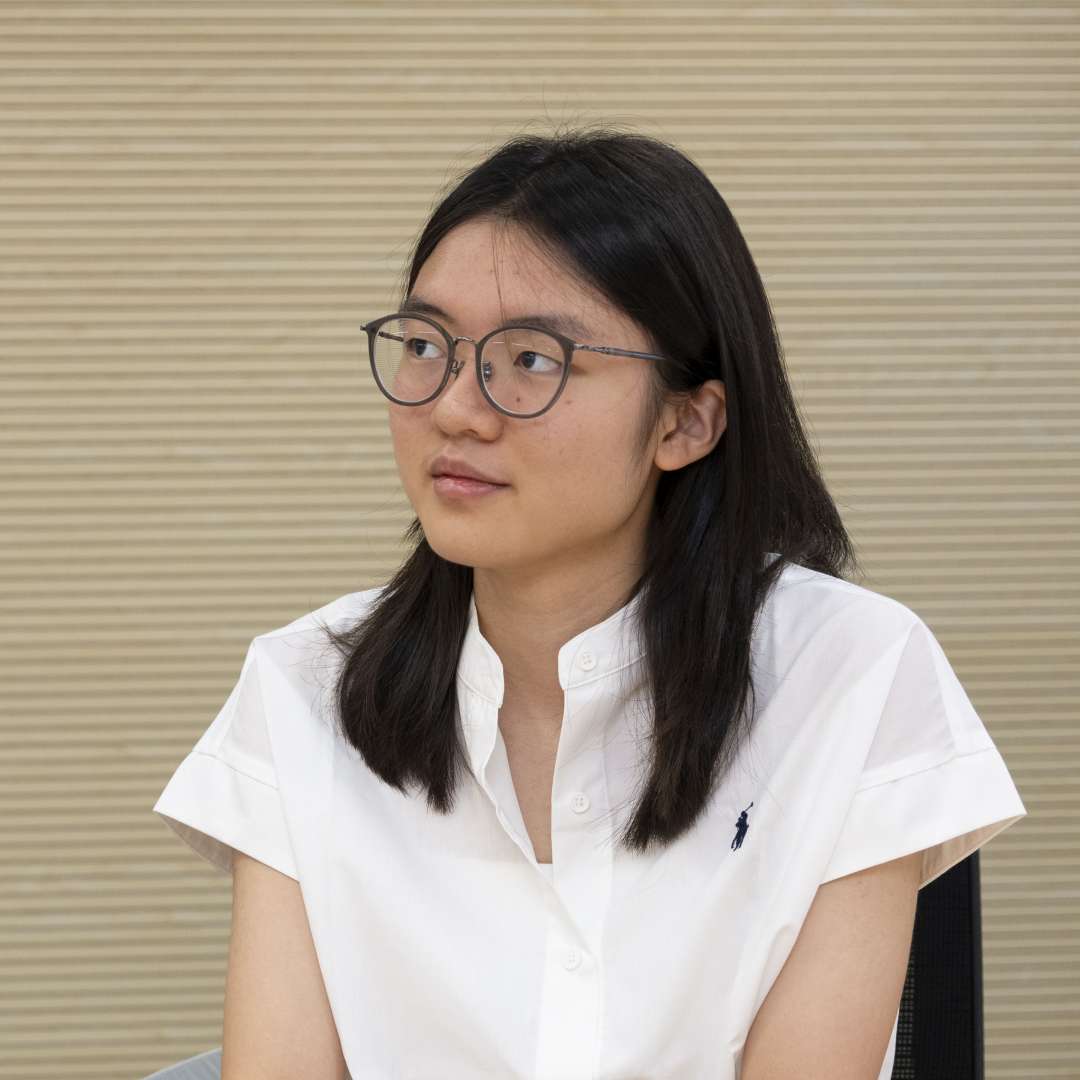
Students at the interview share their takeaways.
Two students from Design Charrette 2026 joined the interview. The programme, “Vertical City: Reimagining Hong Kong’s Skyline,” brought together around 30 secondary school students for an immersive architectural learning experience.
|
|
|