

Youth Speak: What We Follow
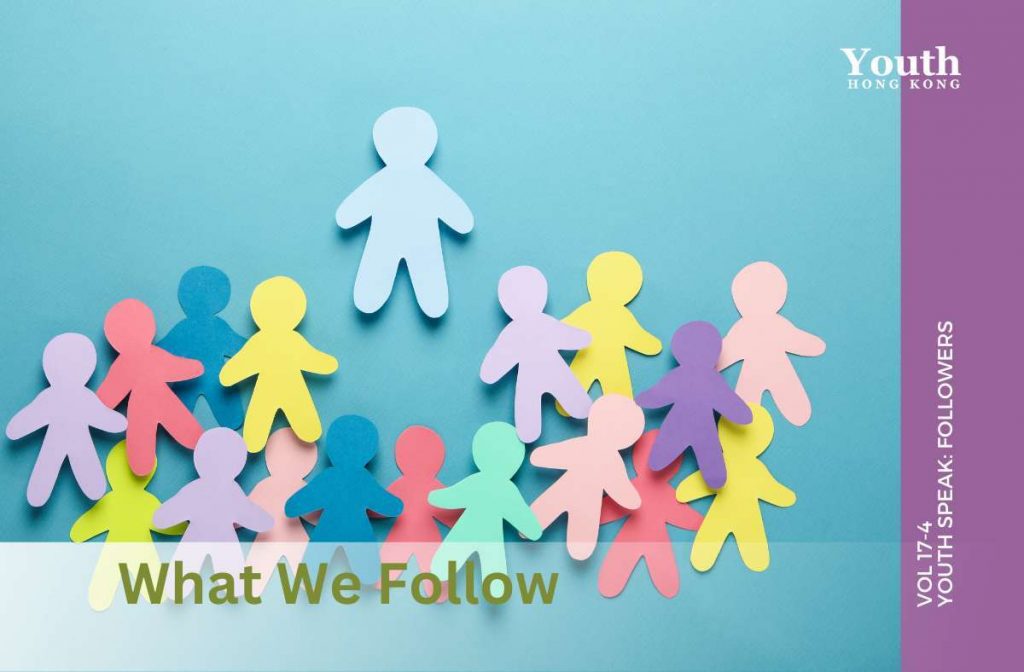
This section explores the complex relationship followers have with online personalities. Drawing on questions about their consumption habits, emotional responses, and views on the shift from traditional fame, young people share how they navigate the online space, managing feelings of social comparison, and defining their own identity.
I mostly follow fashion influencers, not necessarily to copy their outfits directly, but to appreciate the inspiration and ingenuity behind their style. I’m often “wowed” by a look that is visually stunning and aesthetically pleasing, particularly when it features striking cover photos with amazing colour and material contrasts, or styles that I can realistically adapt into my own wardrobe.
I choose to follow someone when their content gives me a sense of relaxation, novelty and connection. I also use social media to unwind in my free time and look for new information or perspectives. Beyond that, I tend to follow people whose personalities immediately resonate with me. I am not averse to unfollowing them, either if any of these factors change or if I haven’t been paying attention to their content for a while.
As the influencers who most influence me shape my sartorial style, I would say that they, along with the rise of live-streaming e-commerce on Chinese platforms, have affected my spending habits, leading me to shop more frequently than before.
They also shape my aspirations. Many fashion influencers come from wealthy backgrounds and showcase a high-consumption lifestyle. While I’m not interested in luxury goods, I do appreciate beautiful things. Seeing how they (and other fans) are able to purchase certain items has made me feel the clear economic gap, and at times, I feel a sense of envy — even pressure — when I see them dressed exquisitely or owning beautiful items.
However, I counter this pressure by reflecting on why I feel this way. I don’t actually desire luxury goods, but simply appreciate beautiful things, which I know isn’t limited to expensive clothes. Most importantly, by focusing on other aspects of my life and what I find meaningful, these feelings of frustration usually pass.
Compared to the distant, untouchable aura of traditional celebrities, current influencer culture feels more accessible and relational. Instead of movie stars on a red carpet, I’m following someone who feels like a peer, someone who lives close to me and shares my interests, obviously because of the proximity of social media.
In fact, I believe influencer culture is a complex and inevitable part of modern media. On the positive side, it’s a source of inspiration and information on niche interests. It can feel more democratic, allowing anyone with talent or a unique perspective to build a platform. On the negative side, it can promote consumerism, create unrealistic lifestyle expectations, and, as I myself experienced, highlight social and economic inequalities in a very personal way.
I feel drawn to influencers who offer food for thought. Ideally, I want to use the internet for educational content the most, whether neuroscience professors like Andrew Huberman or podcasters like Steven Bartlett.
When an influencer’s content, or online presence, becomes infested with drama, or they lose sight of their original purpose to educate themselves and their viewers, I find myself losing interest. In the same way, if I stumble upon a piece of content that seems to live up to my standards of quality, I follow it. That standard means I look for influencers who approach followers in good faith, trying to teach, rather than selling one-size-fits-all content. I am not looking for answers or rules to live by from people who might, or might not, know better than me. I am looking for fuel to feed my thinking, which will, in turn, help form my views on how I choose to live my life.
I see a stark dichotomy within influencers. One group operates in good faith and is driven by purpose, while another is driven by money or fame, exploiting their followers, potentially rendering them worse off in the process. This latter group is the descendant of traditional celebrity culture, adapted to modern media platforms. Their content is toxic drama, delivered in an entertaining fashion, which normalises and romanticises it. The former group, on the other hand, might sometimes need to market their content in a similar way, in order to survive. However, their content, while perhaps being more worthwhile, may not be as entertaining.
Finally, let’s not forget a third category of so-called “gurus.” Their content is similar to the first group, but their approach differs. They aim to instruct and almost indoctrinate, rather than just provide food for thought. They take the responsibility of decision-making and value-setting above the follower, and to provide a digestible, easy-to-follow solution. Their popularity is because many followers want easy answers and simple ways on how to live or behave. So, if someone convincingly claims to have it all figured out, we want to believe them. In those moments, I believe, we should commit to thinking for ourselves and work out our own responsibilities.
Influencer culture can range from healthy to toxic, and from meaningful to completely shallow. I understand that there is a lot of potential for growth in some content, but I also see a lot of harmful models peddling destructive lifestyles. What can unfailingly shift us towards the better end of both spectra is being mindful of how and what we consume: thinking through content rather than letting it slowly shape us through sheer exposure and popularity.
I mostly follow dance creators because I love dancing. But the feelings I get from watching them are mixed. On the one hand, it pushes me to improve. Seeing others dance so beautifully makes me want to work harder, to reach that same level of natural flow. On the other hand, it can be anxiety-inducing. Especially when I realise that some of these brilliant dancers are my age, or even younger, performing on big stages and surrounded by fans, I can’t help but compare myself to them. That sometimes makes me feel inadequate.
I’m learning to make peace with that. I remind myself that dance is about personal expression, and what’s “excellent” on social media doesn’t need to be copied. Rather, it can be a mirror, helping me discover who I am.
I do understand why so many people today are glued to online content. My younger brother is obsessed with YouTubers in gaming and music. Honestly, I worry about him getting lost online sometimes. That kind of obsession says something about our generation.
We grew up in a world of instant gratification — tap once, and you get pleasure right away. Compared to that, things that require long-term effort, like reading, are getting harder to sustain. My brother isn’t necessarily lazy; it’s just that he’s been conditioned by the pace of this era to crave immediate rewards, and the environment is reshaping young people’s patience and attention.
That said, I don’t completely reject “influencer culture.” In fact, I think there’s something positive about it. It’s opened up new possibilities. In the past, if you wanted to be seen or become famous, there were basically two paths: acting or singing. Those industries were tiny and incredibly hard to break into. You needed the right look, the right connections, and a fair amount of luck, often backed by family or money. Honestly, that whole model of fame was unequal from the start.
But social media is different. You can begin from an ordinary place, simply sharing what you love, showing what you’re good at, or just living your life authentically and energetically. People will still watch. You don’t need to be “chosen” by the entertainment industry; you can choose yourself. That, I think, is a real shift. It’s turned visibility from an elite privilege into something far more accessible.
It’s not just about fame. It can even become a career. You can gradually turn your personality and interests into something that sustains you financially. Today, not everyone wants to follow the traditional route, like the big-company internship, the stable job, all the way to retirement. Social media gives us the illusion that “who we are” can shape “what we become.” But the reality is that not everyone can just post a few clips and start making money. There are still gatekeepers — algorithms, traffic, platform rules — that decide who gets pushed to the top.
So I don’t see influencer culture as simply shallow or attention-seeking. It’s a way of redistributing the power to speak. You can influence others through your voice, offering them resonance, comfort, inspiration, or just a glimpse of another way to live. And that, to me, feels meaningful.
For me, online content is more of a way to relax than something I take seriously or try to imitate. Compared with those who share strong opinions or political views, the influencers I follow are mostly funny, pet-related, or stress-relief creators, the light-hearted kind. Of course, social media can sometimes be stressful, giving me anxiety when the algorithms amplify people who stand out.
The reasons I follow certain people are simple: their content makes me feel relaxed, happy, or in some way, understood. For example, I like watching overseas student vloggers whose experiences are similar to mine. That sense of similarity makes their content relatable, and it makes the online world feel a bit more real.
That said, I do unfollow people sometimes. Many creators, once they gain popularity, start filling their content with ads and sponsorships and drifting away from genuine expression to commercial formulas. The sincerity and creativity that drew me in at first often get replaced by polished marketing. When “sharing” turns into “selling”, when jokes come with product links, it just feels hollow.
I’m cautious about who I follow, because I know how fleeting online fame can be. A meme can be overused in a week; a creator can go from viral to forgotten just as quickly. For me, who I follow doesn’t really matter. What matters is what kind of content helps me find connection or emotional release. That feels more authentic — and definitely more freeing — than chasing short-lived hype. Instead, I tend to let the algorithm do its thing. It might be impersonal, but it’s surprisingly good at showing me content that matches my mood or curiosity in the moment.
I think today’s internet culture is a mix of empowerment and superficiality. Anyone can post, go viral, or be seen, which makes creativity more democratic than ever. The barriers have fallen; everyone has a shot at being noticed. But at the same time, that visibility comes with a cost. Traffic can give you a new identity or a polished moment in the spotlight. But it can also turn against you.
The fragility lies in this: going viral isn’t hard; sustaining it is. To keep people’s attention online, you need to constantly innovate and stay perfectly in tune with public sentiment. One sentence, one opinion can change everything. For example, a creator once discussed why graduate employment rates were low, but a few poorly phrased comments ended up offending young audiences and led to a huge backlash.
Cases like that remind me that in the age of algorithms, expression is both free and risky and a double-edged sword. Being “famous” doesn’t necessarily mean being “understood”. Algorithms can magnify a single moment, but they can’t sustain genuine value. Social media has given everyone a stage to show who they are, but it has also made reputation more fragile, more fragmented even, than ever.
I don’t follow a single person or name, but I consistently engage with several inspiring pages and channels. On Instagram, my favourites include mindset.therapy, pathsofstoicism, and goodmindsquote. When it comes to YouTube, I enjoy channels like Better Than Yesterday, The School of Life, and TED-Ed. I am primarily drawn to content centred around self-development, self-help, practical philosophy, and other insightful subjects that encourage reflection and personal growth. Essentially, I seek out anything that helps me strive to be the best I can.
My decision to follow someone hinges on whether their content genuinely adds value to my life. This can manifest as education, entertainment, or simply a sense of comfort, such as something fun or relaxing, balancing learning and relaxation. Conversely, I will usually unfollow when an account becomes overly promotional, appears fake, or wastes my time unnecessarily.
I believe influencers can have a meaningful impact. The specific channels and pages I follow have positively influenced my personality, productivity, thinking patterns, attitudes, and personal traits, as I actively attempt to put their advice into action. Since this influence is often intellectual and emotional, it can be difficult to fully articulate its depth.
Sometimes I want to live up to what I see online, but my reactions are mixed. On the one hand, I sometimes feel pressure because the advice is often good and practical, prompting me to ask why I shouldn’t implement changes that could improve my life overall. On the other hand, it can feel like an 「information bomb,」 which I recognise are challenging to sustain. Therefore, I try to maintain a necessary balance by being highly selective about what I consume and by taking regular breaks.
Influencer culture fundamentally feels more personal and accessible than traditional celebrity culture. Unlike older forms of fame, influencers often share aspects of their daily lives and interact directly with their followers. However, it’s vital to remember that it is still social media, and it remains difficult to discern what is truly authentic versus what is promotional or manufactured content.
I believe influencer culture is a curious mix of the positive, harmful, healthy, and meaningful. It is ultimately an undeniable part of modern media, and just as one cannot label the internet as being ‘good’ or ‘bad’, the same applies here.
Outcome truly depends on the individual, what they consume, how they consume it and whether it is used for growth and well-being. Blindly chasing unrealistic standards or following content indiscriminately can certainly be harmful. We must accept that influencer culture is now a major fixture in modern media, and it’s our responsibility as viewers to engage with it critically and consciously.
As I mentioned earlier, I cannot point to a single modern “influencer” who deeply inspires me. As a millennial at the core, I am still primarily influenced and inspired by profound achievers and legends like former Indian President APJ Abdul Kalam or former American President Abraham Lincoln; Indian physicist and Nobel Laureate Sir C V Raman, Nobel Prize winner Marie Curie, or tennis player Serena Williams. The list goes on…
We all follow influencers on social media for different reasons. Personally, I enjoy watching vlogs on YouTube — they give me a sneak peek into someone else’s world. It’s strangely comforting to see people sharing snippets of their lives.
But having worked in marketing has made me more mindful of the “influence” behind this culture. Influencers fuel materialism and consumerism, which worries me, as overconsumption lies at the core of many issues like pollution and inequality.
Recently, I came across a YouTube video titled “Influencers don’t care if you go broke,” and someone commented, “Their job is to take money out of our pockets and put it in theirs.” I agreed, though ironically, I only found the video through an influencer I follow, called Cara Nicole, the “financial freedom girl” who makes video essays.
At the end of the day, influencer culture is a double-edged sword. While it brings out creativity, it’s also quietly changing how we make purchases, decisions, connections, and more — but the choice to be “influenced” is in our hands. ■