

This section explores the lived experiences of content creators. Through their personal stories — from their creative beginnings, moments of burnout and negotiating audience expectations, to the pursuit of authenticity, they reflect on what it truly means to build influence today.

Always Exploring
Becoming a creator was a complete coincidence. In 2014, during an internship in Shanghai, I was randomly interviewed for a street show and later invited to become its host. The video received great feedback — that was when I realised that creating content could be a profession. At first, I followed audience reactions, but later I discovered what I truly love: travelling, meeting people, filming, and sharing stories. Growing up in Hong Kong, an international city, I was lucky to be exposed to diverse cultures that taught me to see things from multiple angles. I hope to use videos to connect people, making content a dialogue between my own interests and what audiences want to see.
My motivation is to step out of my comfort zone. Many people think that means simply trying new things, but for me, it’s a mindset of facing the unknown and still choosing to express myself. I’m quite “thick-skinned”: I dare to talk to strangers, film on the streets, and in doing so, I push my limits. When I take that step, viewers see that being brave is possible too. This mutual encouragement keeps me going.
I began with light-hearted themes, such as where girls prefer to go on a first date, but gradually moved towards more complex topics, for example exploring different jobs in Hong Kong. This shift reflects my growth, and my audience is growing with me.
The hardest part of being a creator is coming up with good ideas and starting from scratch. I wasn’t an overnight success; I built my audience video by video. In the beginning, I had no resources or guidance. Even small things, like deciding my hairstyle, were my job. I kept experimenting, trading time for experience. Later, when I finally had resources, the challenge became how to stay passionate. Creating content means constant repetition — brainstorming, filming, responding to viewers. If it becomes mechanical, the passion fades. So I push myself to try new formats, such as the offline stand-up show I recently did, to keep my creativity alive.
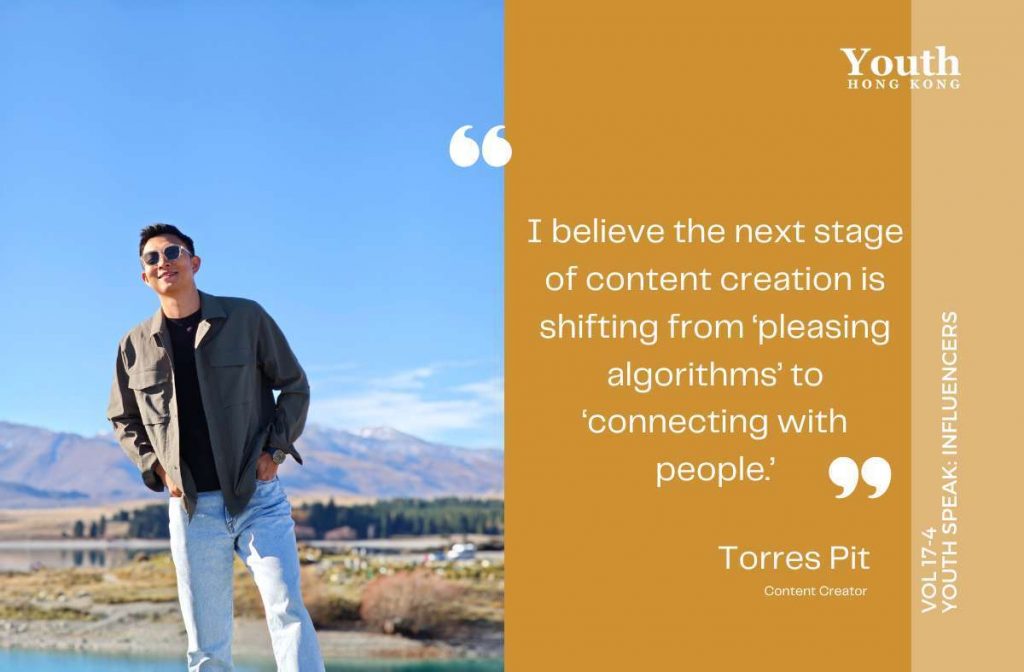
The next stage of content creation is shifting from “pleasing algorithms” to “connecting with people”. Algorithmic exposure brings attention, but only genuine connection builds trust, and that trust is the most precious gift a creator can have.
The online ecosystem has changed dramatically. People are getting more picky because viewers are spoiled now. The rise of AI, which is capable of generating high-quality videos in seconds, has made human connection more important than ever. Face-to-face events, though smaller in scale, feel more genuine. I believe the next stage of content creation is shifting from “pleasing algorithms” to “connecting with people”. Algorithmic exposure brings attention, but only genuine connection builds trust, and that trust is the most precious gift a creator can have.
If I could speak to my younger self when I first started, I’d probably say, “It’s too hard, don’t do it” (just kidding). When I graduated, I didn’t rush to find a job, and before I knew it, that “hobby” had become a journey. Creating is like climbing a mountain — halfway up, you realise the peak is farther than you expected, yet you keep going. I’m glad I never quit. Over the years, I’ve learned life lessons beyond books: how to live with pressure, and how to pause and look back. Growth isn’t just about moving forward all the time — it’s about staying clear-headed through the ups and downs, and sometimes taking a step back to reflect.
To young creators, I want to say this: I once made 30 to 40 videos that no one watched. But I’m glad I made those first forty, because without them, I wouldn’t have built my career. You never know when or where that turning point will come. No one can tell you, “Just make one more video and you’ll make it.” You simply have to keep trying. In the end, it depends on how much you love it — so don’t do it unless you truly do.
If one day my child wants to become a creator, I’ll support them. By then, platforms may change, but the message will be the same: if you genuinely love it, go for it. I probably won’t help them promote their work, because I don’t know where I’ll be by then, and I’ve always taken life one day at a time. Just like seven years ago, I couldn’t have imagined being where I am today. Life’s like that — you never know what will happen, but you can always choose to explore. ■