

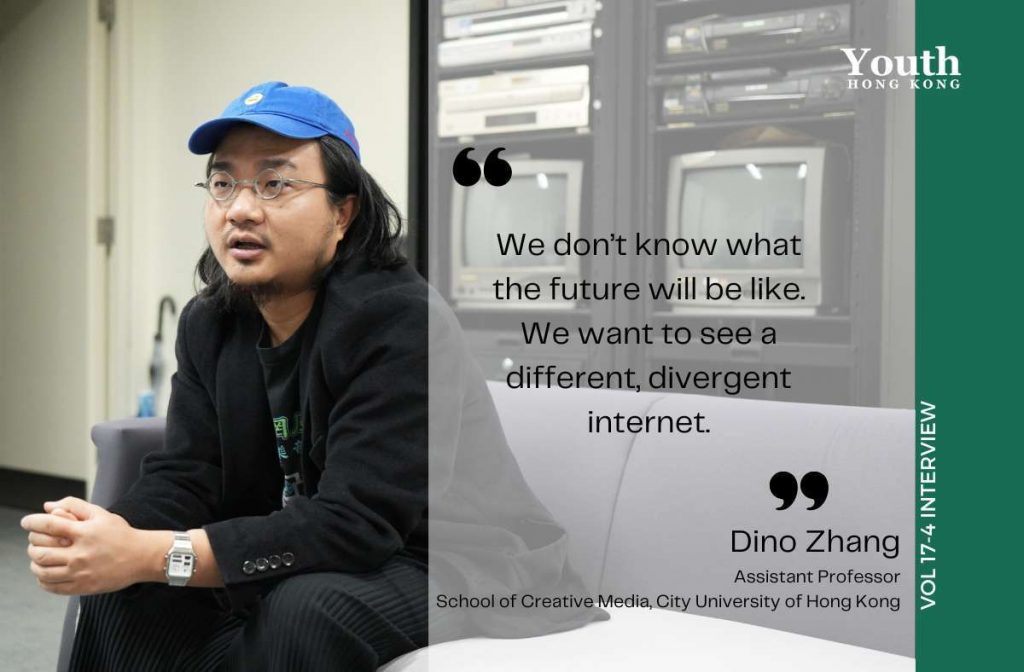
While many dismiss influencers as shallow, Assistant Professor Dino Zhang argues that only by understanding the history of online content can we shape a more diverse and meaningful digital future.
At a crowded lunch spot, diners with wearable cameras are describing each bite they eat. On a Hong Kong footbridge, domestic workers on picnic mats are coaxing one another into TikTok dances. Around the corner, a cluster of schoolboys records a new viral drink challenge. For many passers-by, the instinctive reaction is a quiet, mumbled: Ugh, just another influencer wannabe.
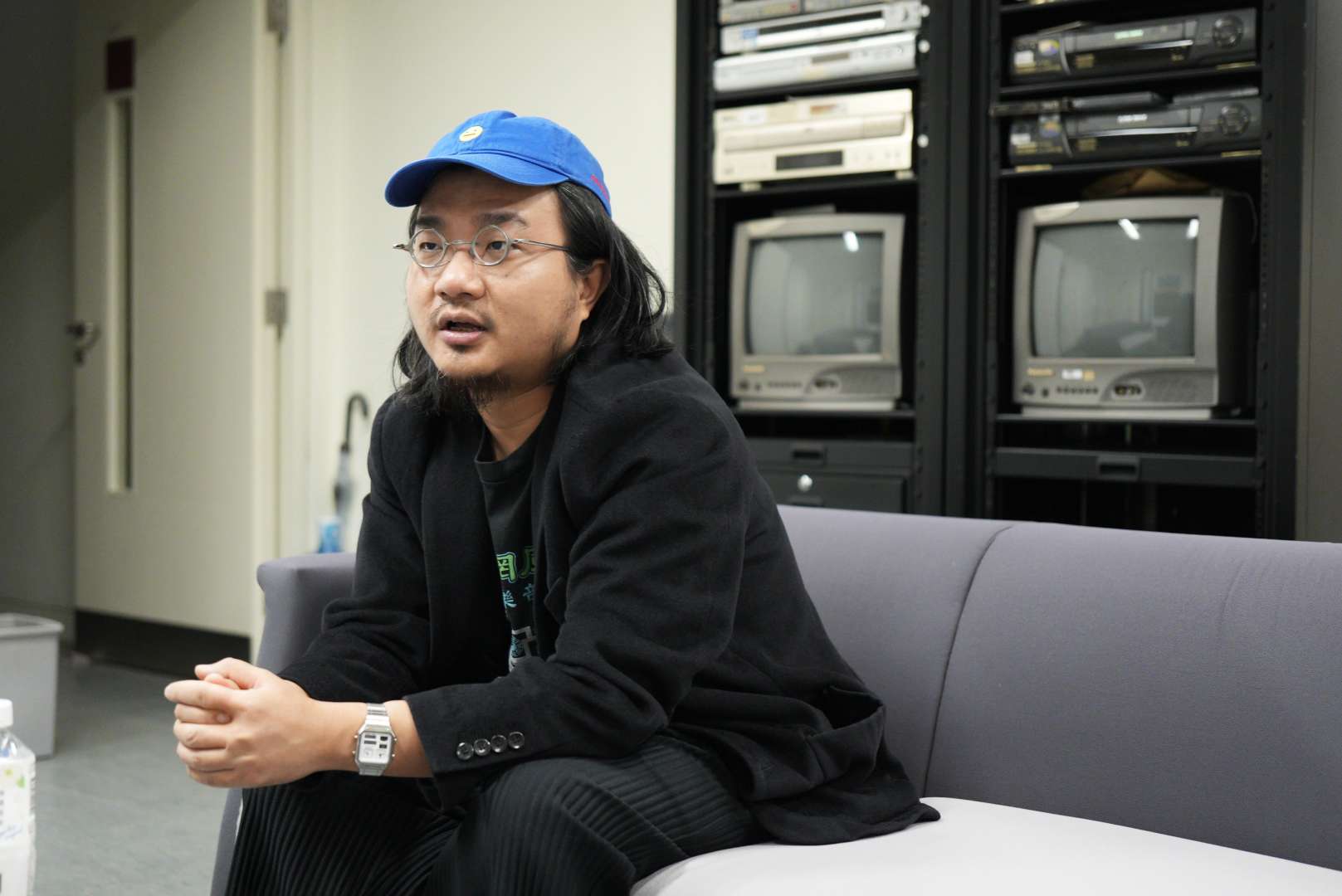
“We’re living in a society where being an influencer means being something extremely banal. There’s nothing special about it,” says Dino Zhang, Assistant Professor at the School of Creative Media, City University of Hong Kong (CityU). Speaking to Youth Hong Kong, Dino shares his observations on the evolution of influencer culture, delving into its history, social impact and future, in an era of ever-increasing algorithmic content and AI-driven platforms.
A Culturally Nuanced Lens
Despite influencers becoming a part of daily life and shaping young people’s aspirations, Dino says society still tends to dismiss this phenomenon as “a bunch of kids doing random things online and not contributing to society.” To understand this culture better, the School of Creative Media in 2023 launched the Influencer Studies Stream, a postgraduate programme of which he is Deputy Leader. The course examines contemporary influencer practices through a nuanced lens of history, cultural theory, political economy and different social media platforms.
“We ask our students to look beyond content and consider the theory of aesthetics and internet history to understand how we have arrived at this point and what the future might hold. This is critical, especially given the incoming flood of AI-generated, commercially driven, homogeneous content.”
And this less diverse online environment, as he elaborates, is a problem that needs to be understood and addressed through this programme.
This innovative approach contrasts with university programmes that focus more on marketing, business or social media content creation. Instead, it prioritises critical thinking, steering students away from adopting a narrow entrepreneurial business mindset that emphasises marketing, generating views and attracting advertisers, explains Dino. “We are not saying money does not matter, but we also need to understand how things work on different platforms from a wider socio-economic and cultural perspective.”
What is now known as the global creator economy is estimated to have a current market value of around 250 billion US dollars, a figure projected to double by 2027, according to Goldman Sachs. Advertising Agency OMD’s Hong Kong Youngster Social Media Behaviour Survey reveals that young people spend 2.5 hours on social media each day on average, primarily on video-hosting platforms such as Instagram, Facebook and TikTok. They use influencers on these platforms to stay updated on the latest trends.
Tracking the Evolution
Today’s consumers, especially the younger ones, want greater agency and are increasingly moving away from traditional forms of entertainment, says Dino. Rather than watching TVB, a Hong Kong commercial television station, young people turn to YouTube channels like Mill MILK for videos on local culture and lifestyles. “They no longer want what TV channels offer,” a shift, he says, that “is evident in how local beauty contests, once prestigious, have become subjects of ridicule.”
Understanding this change is central to the study of today’s influencer culture on the CityU programme. It can be seen when tracking online culture from early webcam and text-based websites, to the streaming platforms that became mainstream in the mid-2000s, and then to the monetised models that now allow creators to turn hobbies into careers.
Even the production process has changed. Over the past two decades, online content has evolved from loop videos and troll pranks to today’s highly polished productions, sometimes with equipment more sophisticated than TV studios.
Dino uses Vine, an entertainment network founded in 2012, as an example. Now a defunct mobile app, Vine began by allowing users to create and share six-second, loop video clips. It was the pioneer of short video sharing, with users such as Logan Paul, an American influencer, who subsequently became a giant with 23 million subscribers on YouTube today.
“We want our students to understand the shifts in social media, and YouTube is a good example,” says Dino. “In the past, its content was not valued in the way it is today when it is overtly monetised.” This does not create a dichotomy between past and present. Instead, he stresses, it is simply an evolution, a continuation and construction based on the past.
“Things are always both new and old, at least in the media landscape,” he points out. “Live streaming and the concept of a ‘channel’ are borrowed from television. Even the para-social intimacy people feel with small influencers resembles an older culture, such as that of underground idols from Japan.”
“People love underground idols, because the created intimacy means one can develop a closer relationship based on meeting and talking to them more often, almost like friends,” he continues. “Fans”, he explains, “don’t necessarily seek authenticity; they enjoy a relationship with a performed identity.” Herein lies the social contract. “There is continuity with the old media in the new media, and we want our students to recognise that.”
Concerns and Misconceptions
As influencer culture is devoured by followers and becomes increasingly ubiquitous, officials have begun to assess motivations, impact and cultural consequences. Are they beneficial or detrimental?
“Many people enter this space wanting to be famous. That entrepreneurial mentality is always there,” Dino says. “But realistically, no one should set ‘one million subscribers’ as a life goal. A healthier approach is to make content you enjoy and engage with your audience. Sometimes your channel grows; sometimes it doesn’t.”
Becoming famous and making lots of money does not equate with making the internet space better. Instead, according to Dino, it results in what he calls the “homogenisation of content.” “It’s bad for society when everyone talks about the same things. We should have diversity.” Part of the School of Creative Media’s goal, he says, is to help students look beyond money, the ephemeral and the superficial, and to develop the ability to analyse a broader historical and cultural landscape of social media critically.
This holds true even when considering different influencer landscapes. The Chinese Mainland and Hong Kong social media have grown in contrasting directions, says Dino. On the mainland, the absence of a robust advertising revenue model has pushed creators towards live commerce as the only viable way to earn. This has produced an ecosystem where e-commerce dominates creator behaviour. In Hong Kong, by contrast, a hybrid environment has been influenced by models and platforms from both Western countries and China.
In spite of these variations, the debates remain the same. For instance, do short videos shorten attention spans? Dino remains sceptical. “It depends on the platform. YouTube promotes long-form content that people even use to fall asleep,” he says. “I want students to avoid oversimplified claims and instead learn to appreciate the deep insights the internet offers, if they have the eye to see them.”
The initial optimism about the internet as a democratising force has faded, especially after the rise of Facebook and YouTube over 20 years ago. Having witnessed the growth of extreme views, violent content and misinformation, Dino remains pessimistic about issues such as censorship and harmful content. Nevertheless, he acknowledges that the online world still contains “profound” material and information. What is essential, especially for students and young people, he explains, is discernment and an enhanced human curatorial process that allows for the positive in a landscape increasingly shaped by algorithms and AI.
“Algorithms give you an infinite amount of content, but do not necessarily give you what you actually want. I think to a degree, people don’t know what they want until they see it,” he says. Almost like the consumption of art: it is all a matter of subjectivity. Similarly, machines can’t entirely predict human preferences: “It’s accidental; it’s not expected, and therefore, we need to be discerning.”
A Diverse Future
So, what is the conclusion? According to Dino, we need to be attuned to progress. While there are concerns about an internet overrun by AI-generated material, he believes that there might eventually be nostalgia and, therefore, demand for authenticity and imperfection. Glossy productions might no longer be admired, vis-à-vis the old grainy, unpolished clips of yesteryear. “In that sense, imperfection becomes desirable and a new aesthetic,” he says, illustrating Marie Antoinette, the last Queen of France’s point that “there is nothing new except what has been forgotten.”
“We don’t know what the future will be like,” he says, “we want to see a different, divergent internet.” For the internet to survive, especially when it is flooded with AI-generated content and chatbots, Dino says we need to find a strategy that once again provides new imaginings for both creators and followers. ■